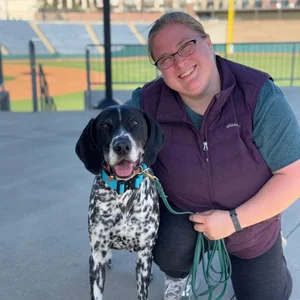
We Build People the Same Way We Build Dogs
The longer I teach, the more convinced I become that the principles that build great dogs are the same principles that build great handlers.
We spend so much time talking about splitting criteria, building confidence, reinforcing success, and teaching one skill at a time when we’re working with our dogs. We understand that if we ask for too much too soon, learning falls apart. And yet it’s surprisingly easy to forget that the person on the other end of the leash learns the same way.
As instructors, we often spot a dozen things that could be improved. But just because we can identify twelve problems doesn’t mean all twelve are equally important, and it certainly doesn’t mean we should try to fix all of them at once. People, just like dogs, have a finite amount they can process at one time.
I think one of the most important skills a coach can develop is the ability to identify what matters most right now. Not the longest list of mistakes, but the one issue that’s having the biggest downstream effect. Often the things we notice are symptoms rather than root causes, and fixing one problem can quietly solve five others. Everything is connected.
That’s also why I think it’s so important to build people the same way we build dogs. We don’t expect dogs to learn source commitment, confidence, decision making, communication, independence, and trained final response behaviors all at once. We split those skills apart, teach them intentionally, and layer them together over time. Why would we coach humans any differently?
Confidence, momentum, encouragement, and success matter for people just as much as they do for dogs. If every lesson is just a list of mistakes, people stop taking risks. They start second guessing themselves. They stop trusting their instincts. And eventually, they stop learning.
I’ve found that the most productive coaching sessions aren’t the ones where we cover the most ground. They’re the ones where we focus on the right thing. The goal is to identify what will move that person — and the team — forward the most. Sometimes the most effective thing you can do as an instructor is intentionally not mention the other eleven things you noticed, because clarity is often more valuable than completeness.
There will be another repetition. There will be another class. There will be another opportunity to polish the details. You don’t have to fix everything today because the goal isn’t instant perfection; it’s progress. The best coaching isn’t about saying everything you know. It’s about knowing what will move someone forward next.
At the end of the day, I’m not just trying to train better dogs. I’m trying to build better teams. And that means building the person on the other end of the leash with the same patience, intention, and kindness that I try to bring to the dog.