What Makes a Good Detection Dog? Why More Isn’t Always Better
What makes a good detection dog? The answer is a little more complicated than just “a dog with a lot of drive.”
I actually have a pretty good example of this living in my own house. Kieran is basically the Ferrari of dogs. He is very high drive, high arousal, intense, fast, and wants to put everything he has into whatever we’re doing. For me, he’s incredibly fun to train and work, but I’ve also spent a lot of years learning how to handle dogs like him. And just like a Ferrari, having all that power is only useful if you know how to drive it.
Kieran isn’t even two yet, and a huge part of raising him has been intentionally channeling all of that intensity into the dog I wanted him to become. Today, he’s pretty darn close to my perfect dog. He’s incredibly capable, loves to work, and has learned how to turn all of that intensity into something productive. But he’s also a lot of dog, and that’s not a negative. It’s part of what makes him so good at what he does. It also means he wouldn’t necessarily be the right dog for every handler.
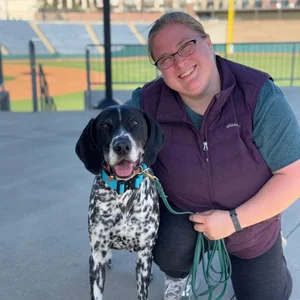
Lark, on the other hand, is different. He’s still a medium-to-high drive dog, but he has considerably less arousal and intensity behind it. He’s naturally more chill. He has plenty of desire to work, but there’s a little less Ferrari and a little more daily driver. For a less experienced handler, that can make him much easier to train, live with, and maintain. There are pros and cons to both, and neither one is inherently better.
That’s one of the reasons I don’t love talking about detection dogs simply in terms of “high drive” or “high arousal.” They’re not the same thing, and more isn’t automatically better. When I’m looking at a dog for professional detection work, I care about hunt drive, persistence, independence, environmental confidence, resilience, reward value, problem-solving ability, arousal, and the dog’s ability to regulate that arousal and continue working effectively. I need a dog who genuinely wants to hunt and will keep working when the answer gets difficult, but I also need a dog who can think while they’re doing it.
And all of those traits exist on a spectrum. The right combination depends not only on the work we’re asking the dog to do, but also on the person who’s going to be handling and living with that dog. A dog can have all the raw ability in the world and still be a poor match for a particular handler. Part of selecting and developing a professional detection dog is looking at the entire picture: the dog, the job, the handler, and whether those pieces actually fit together.
That’s also why I don’t think there’s one universal picture of the “perfect” detection dog. Different jobs place different demands on dogs, and different handlers are going to be successful with different types of dogs. If I’m helping select a dog for professional work, I’m not looking for the most dog I can possibly find. I’m looking for the right dog for that particular job and handler.
A lot of this carries directly over into scent sports. If I were intentionally selecting a dog with the goal of competing at the upper levels of nosework, honestly, many of the qualities I’d want would be the same ones I value in a professional detection dog. A dog with exceptional hunt drive, persistence, independence, environmental confidence, resilience, and the ability to work through difficult problems is going to have a pretty nice set of tools for either job.
Where sport becomes different is that the door is much wider. A dog doesn’t have to meet the standard I would expect from a professional detection dog to be successful in nosework. There are plenty of dogs who wouldn’t be appropriate for operational work that can become really nice sport dogs, compete successfully, and have a whole lot of fun doing it. Maybe certain pieces require more training or thoughtful handling, or maybe there are limitations we learn to work with, but that’s part of developing the individual dog.
And then there’s an entirely different starting point that I see all the time as a trainer. Instead of saying, “I want to do upper-level nosework, help me find the dog for that goal,” someone comes to me with the dog they already have and says, “I think we’d really enjoy doing this together.”
I love that too.
In that situation, I’m not trying to turn that dog into my idea of the perfect detection dog. I’m figuring out who that dog is, what they naturally bring to the table, what we can develop, and how far that particular team wants to take it. Maybe they don’t naturally have strong hunt drive. Maybe they’re hesitant to leave their handler. Maybe they give up quickly when something gets difficult, or the environment matters too much right now. Within reason, we can develop a lot of those qualities. That’s part of the skill of training — not just recognizing the traits that already exist, but knowing how to bring out more persistence, independence, confidence, engagement, and desire to search in the individual dog you’re working with.
That dog doesn’t need to be Kieran. Honestly, most dogs don’t. They don’t need to be professional detection dogs, either. Sometimes the goal is serious operational work. Sometimes it’s chasing upper-level sport titles. And sometimes it’s enrichment, building a better relationship with the dog you already love, and discovering something really fun that you can do together.
There is no single perfect detection dog. There’s the dog, the handler, the training, and the goal. Figuring out how all of those pieces fit together is a whole lot more interesting than simply asking how much “drive” a dog has.