Decision Making Is a Skill, Not a Milestone
A lot of our nosework dogs aren’t struggling because they can’t solve the problem. They’re struggling because nobody ever taught them how.
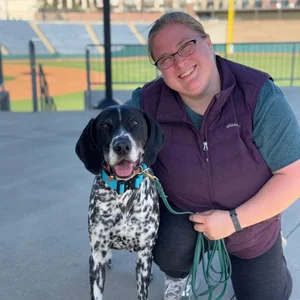
Tavi is a great example of this.
Tavi is almost 11 years old now, and one of the biggest lessons he’s taught me as a trainer has nothing to do with odor. It has to do with decision making.
When Tavi was younger and I was still early in my nosework journey, I was taught that if we gave dogs enough searches, they would eventually learn how to work through increasingly difficult odor problems and tell us where the hide was. Looking back, I think we expected dogs to learn skills we never actually taught.
One of the things I talk about a lot with students is teaching dogs to color in shades of gray. In detection work, we’re constantly asking dogs to make decisions. We expect them to work through conflicting odor information, decide what is relevant, determine when they have enough information, and then communicate that information back to us. The problem is that those skills don’t automatically develop just because a dog has done a lot of searches.
To be clear, I don’t think the answer is skipping foundation work. When I start dogs, I absolutely want them driving all the way to the strongest source of odor. I want repetition. I want clarity. I want them learning that the strongest source of odor is where reinforcement happens. That foundation matters. But eventually we have to teach the next step.
Eventually dogs encounter situations where the picture isn’t black and white. Odor moves. It pools. It drifts. Airflow, terrain, and environmental conditions all influence what the dog is experiencing. And at some point, dogs have to learn how to work through that uncertainty and communicate what they know.
That’s where Tavi struggles.
If Tavi can’t get exactly where he thinks he needs to be, he’ll keep working. He’ll move through an odor pool, circle back, check again, and continue gathering information because he hasn’t learned where the decision point is. He wants the answer to be black and white.
Tavi is not unique. I see versions of this same struggle in a lot of dogs. The more dogs I train, the more convinced I am that decision making is a skill that deserves to be taught just like any other behavior. That means breaking the skill into small pieces, creating lots of different odor pictures, teaching dogs where the decision point is, and using markers to help them understand when they’ve reached the correct conclusion instead of waiting for them to somehow discover it on their own.
Because decision making isn’t something that magically appears one day. It’s a trained behavior.
One of the biggest lessons Tavi has taught me is that dogs don’t need us to test them over and over again to see whether they’ve learned to make good decisions. They need us to teach them how.
Looking back, I wish I had understood that sooner.
Today, I start dogs very differently because of him. I’m far more deliberate about teaching decision making from the beginning, and the younger dogs I’ve trained have benefited tremendously from it. As bittersweet as it is, I’m grateful for the legacy Tavi is leaving, even if he doesn’t get the advantage of starting from that place himself.
Sometimes the dog that teaches the lesson isn’t the one who benefits most from it.
But every dog that comes after does.
Photo Credit: Emma Sanders / Sandem Photography